Monday, November 28, 2011

Delhi Agra Jaipur Delhi Tours via Train Journey

Booking Train Trips between Delhi - Agra - Jaipur 

These days its very easy to book train journeys in India. You can simply go to www.irctc.co.in  or www.cleartrip.com here you can book train Journey in India. You need to first create account in these websites.

You can search the train tickets inside your admin area and book them.

For Delhi Agra Jaipur Follow these


Delhi - Agra - best train is 2002 Bhopal Shatabdi which leaves Delhi at 6:15 and reaches agra at 8:15 the station in Delhi is called NDLS and in Agra it is AGC Agra Cantonment
Agra - Jaipur:
Morning: 2195 - AII INTERCITY departs Agra Fort AF 05.10 arrives JP 09.30
Evening: 2965 - GWL UDZ SUP EXP departs AGC 17.40 arrives JP 22.13
Jaipur - Delhi: best to take evening train
2016 - AJMER SHTBDI - JP 17.50 NDLS 22.40

Note : -  If you are using IRCTC, choose Axis Payment Gateway (Axis PG) for making payments. It works faster with non Indian cards.


Other Option - Same Day Delhi to Agra tour by Car for 4000 INR per car.

Sunday, November 27, 2011

Buying a Prepaid Mobile sim Card in India

Dear Friends,
           Some people have question if they are travelling to India should they buy pre paid sim card or use there own phone to make call?

Its better to buy a Mobile Sim in India. Its Quite inexpensive and calls are cheaper.

Best Mobile Companies - Vodaphone, Airtel, BSNL

Requirement if you are Tourist in India - You need a passport copy, 1 Visa Copy , 2 Photographs. You need to provide the address of the place where you are staying.


Monday, November 14, 2011

When a nation woke up and started building - Hindustan Times

Roughly two decades after the British-built New Delhi was unveiled to the world in 1931, the Capital witnessed another slew of hectic construction activity. The public buildings and mass housing projects that came up in the first decade after India got independence, gave shape to the Delhi we

know today.

Delhi saw a huge population explosion after Partition and also became a magnet for migrants from across the country looking for better opportunities in the independent nation’s Capital. The old part of Delhi was already bursting at the seams and New Delhi was not built to accommodate this multitude of people. Also, the Capital needed new institutional and public buildings to accommodate the increasing number of government offices and officials.


Apart from the challenge of creating this infrastructure, there was also a need to create indigenous architecture that would express the ethos of the time.

“The period after independence was that of hope and the feeling that we can determine and develop our own architecture, instead of a colonial power building for us,” said noted architect AGK Menon.

The post-independence Capital saw a complete deviation from the architectural philosophy that marked the colonial building. When Lutyens was planning a new Capital for British India, the idea behind the grand, imposing buildings was to firmly establish the imperial suzerainty of the colonial power. The independent nation’s Capital needed an architecture that would showcase its faith in modernity and progress.

“The need to create our own architecture was expressed in two ways,” said Menon. “Some wanted to revive the past, as seen in buildings like Ashoka Hotel that were modern structures but with Indian characteristics. Others advocated modernism, which was the rage internationally at that time and examples of such buildings are Rabindra Bhawan and the CSIR building at Rafi Marg,” he said.

Independent India’s first PM Jawaharlal Nehru took a keen interest in the architecture of the new constructions, which he believed should portray the country’s commitment to development and progressiveness. So, utilitarian modernism became the template for almost all government buildings that came up in the 1950s and dot the area between central secretariat and at ITO.

Another reason behind the austere facades of these buildings was the acute crunch of funds. All embellishments were done away with and the prominent features of these buildings were horizontal massing of large windows, freestanding staircases and cantilevered porches.

Mass housing projects, mainly meant for government employees, had an even more severe look. Housing complexes that came up in areas like Sarojini Nagar (then Vinay Nagar) and Laxmi Bai Nagar were just simple structures with a lime finish with the only visible features being sun shades over windows and accentuated stair towers.
Spacious houses were built for senior officers in areas like Kaka Nagar and Bapa Nagar. Private ‘colonies’ came up in Malviya Nagar, Lajpat Nagar, Karol Bagh and New Friends Colony in the 1950s and 1960s also saw a deviation from the conventional style of houses. Living and dining rooms were joined, courtyards were out and bathrooms were now attached with bedrooms.

When a nation woke up and started building - Hindustan Times

Sunday, October 30, 2011

Hotels Near NSIC Exhibition Ground

BnB New Delhi Bed and Breakfast is family run Bed and Breakfast accommodation. It is Located Near NSIC Exhibition Ground. 

Sunday, October 16, 2011

Mecca and Madina to get 10,000 Additional Muslim pilgrim this year.

Haj Season to start this year from November 4th till Nov 8th. Indian Government has given permission to Increase no of Pilgrim. There will be more flights to Saudi

Monday, October 3, 2011

Delhi Tour Packages - Delhi must see sights.


Delhi portrays the riches and the multicolored designs of the olden times. The capital city of India brags of having witnessed some of the most important historical moments in the past times. It is a combination of both age old custom, traditions along with the modern values. Delhi tourism provides you with an organized sight seeing tour comprising of best architectural intricacies, various art forms, different historical monuments mingled with the modern buildings and newly constructed malls. Multi cuisines which the capital city offers is another attraction for all the travelers who come here for leisure or for exploring these historical monuments..
Historical connections of Delhi
Earlier known as "Indraprastha' the capital of the "pandavas' so the history of Delhi goes way back to the times of Mahabharta. Other rulers who ruled over Delhi are TheMauryas, Tomars, Chauhans, Rajputs, Lodhis, Khiljis, Tughlaqs, Marathas, Mughals and finally the British .The authority of these emperors can be seen on the standard of living, ethnicity and most prominently with the monuments they constructed .British too left a long lasting impact on the people of Delhi and ever since they left all the national festivals are celebrated with zest, enthusiasm and exuberance.
Architectural Exquisiteness
Delhi travel guide takes you to a distinctive Mughal period.
Red FortThe enormous fort consists of a number of halls like Diwan-i-am (Hall of Public Audience), Diwan-i-khas (Hall of Private Audience), different residential palaces for the kings and queens, private apartments, Moti Masjid (mosque), etc.


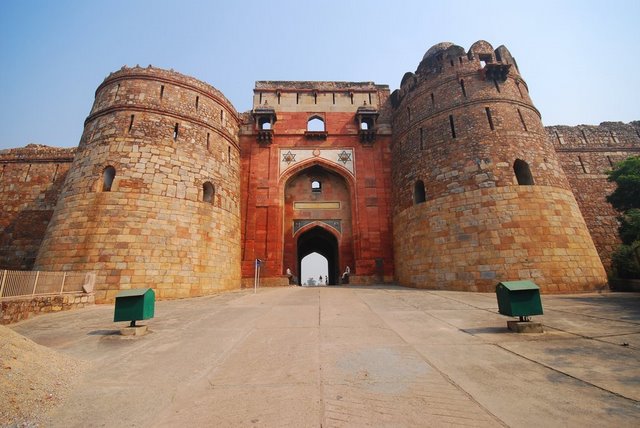
Old Fort
The fort comprises of a lake ,a very old mosque, Zoological Park, and a tower 'Sher-Mandal'.The sound and the light show that portrays 5000 years age old history is another major fascination of this place.


Tughlaqabad Fort
Built by Ghiyas-ud-Din Tughlaq, of which only remains are there.


Qutub Minar
It is 73 m in height comprises of five floors with balconies and many writings which giver us the message of the lifestyle and culture of those times.


India Gate
A beautiful monument for the warriors who sacrificed their lives during the world war -1 and the Afghan war. On every Republic day an annual parade is held to honor these brave soldiers


Humayun's Tomb
The tomb of Mughal emperor Humayun, is famous for its square garden that is divided into four large squares, separated by walkway and canals.


Jama Masjid
One of the biggest mosque in India and is a carbon copy of Moti Masjid of Agra.

Besides this Parliament House, Rashtrapati Bhawan, Lotus temple, Rajghat, and some very beautiful modern buildings and malls are also coming up which is adding to the glory of the capital city.

Sunday, October 2, 2011

1st Asian Symposium on Gay & Lesbian Tourism to be held in New Delhi

1st Asian Symposium on Gay & Lesbian Tourism to be held in New Delhi. It would be starting from 28th November 2011.
The Symposium features educational presentations and networking opportunities for government tourism offices, visitor bureaus, destination management companies, meeting planners, and travel suppliers including airlines, hotels, tour operators, etc. Topics include market research, sales, marketing, advertising, web 2.0, public relations, meetings and events; many illustrated by case studies. 
Enormous interest among LGBT Travelers

India was selected to host the 1st Asian Symposium on Gay & Lesbian Tourism due to its recent emergence on the global “gay map,” resulting from the cancellation of Section 377 banning same-gender relations.


What attracts LGBT Visitors to India is culture, history, temples/religion/spirituality and cuisine.  India is expected to be featured in gay travel publications and websites around the world as a result of this initiative.